HVAC
Cooling, heat pumps, furnaces, ductless systems, ductwork, indoor air quality, thermostat controls, and emergency HVAC work for hot foothill conditions and older homes.
One practical team for cooling failures, panel capacity, water heaters, drains, leaks, heat pumps, EV chargers, and old-home systems across Los Angeles foothill and canyon communities.
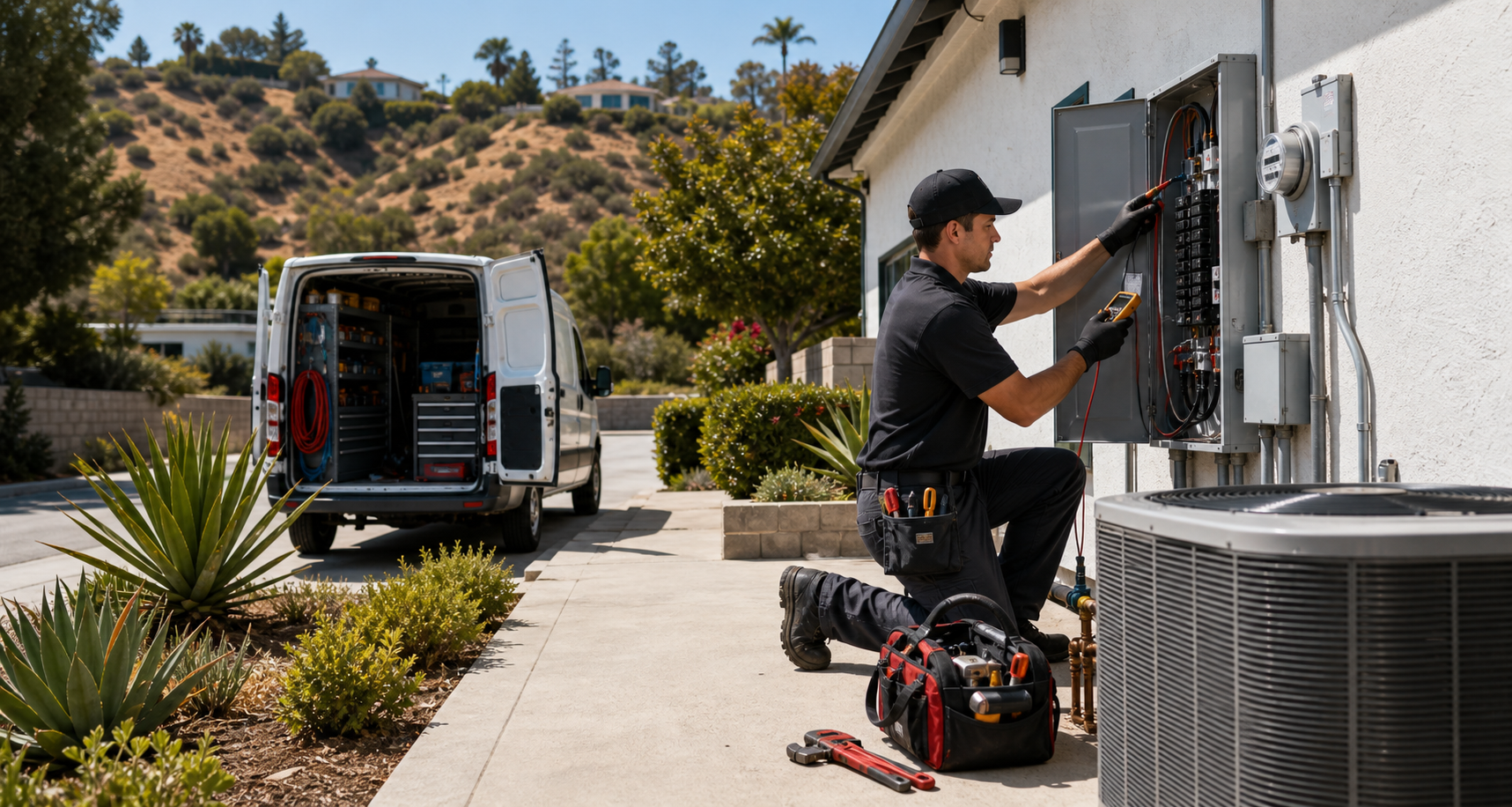
Cooling, heat pumps, furnaces, ductless systems, ductwork, indoor air quality, thermostat controls, and emergency HVAC work for hot foothill conditions and older homes.
Panel upgrades, EV chargers, dedicated circuits, rewiring, lighting, outlet repairs, backup readiness, and urgent electrical troubleshooting where load capacity matters.
Water heaters, tankless systems, drains, sewer camera inspections, leak detection, repiping, fixtures, and emergency plumbing for pressure, slope, and aging-pipe risk.
RidgeFlow Home Services exists for a specific LA problem: older foothill homes where HVAC, electrical, and plumbing decisions overlap. A no-cooling call might expose bad ductwork and a weak electrical disconnect. A heat-pump plan might require a panel review. A water heater replacement might reveal venting, drainage, and dedicated-circuit questions. A sewer backup after rain might be roots, slope, pipe material, or missing cleanout access.
That is why the site is not organized like a thin directory. It is organized by service, city, cost driver, emergency mode, and local friction. The goal is to help homeowners book faster while understanding what could change the scope.
Every visit starts with the visible problem and then checks the constraint around it: utility provider, panel capacity, equipment age, pressure, venting, duct path, cleanout access, permit path, hillside staging, and fire-season exposure. The recommendation should be plain: repair now, replace now, phase later, or monitor with a clear trigger.
That lens matters in Altadena, Pasadena, Sierra Madre, La Canada Flintridge, Glendale canyons, Northeast LA hills, and the San Gabriel foothill corridor because the homes are valuable, varied, and often modified across decades. Speed matters, but a fast wrong scope is expensive.
Most high-cost mistakes in foothill home service come from treating HVAC, electrical, and plumbing as isolated decisions. A new heat pump can expose a panel that was never planned for electrification. An EV charger can crowd the same service capacity needed for a future heat-pump water heater. A tankless water heater can introduce gas, venting, condensate, and electrical questions. A drain problem can point to sewer line damage, root intrusion, or missing cleanout access. A cooling complaint can be caused by duct leakage or return-air starvation instead of the outdoor unit alone.
RidgeFlow pages are written around that sequence because homeowners need to know what the first visit should verify. We separate urgent stabilization from planning work, and we make room for the boring details that decide whether a repair lasts: shutoff access, equipment clearances, breaker labeling, pressure readings, duct condition, combustion air, condensate routing, seismic restraint, cleanout location, utility coordination, and inspection readiness.
The best first visit does more than get a truck in the driveway. It gives the homeowner leverage over the next decision. For a cooling failure, that means knowing whether the issue is electrical, refrigerant, airflow, duct leakage, thermostat control, or equipment age. For a panel or EV charger request, it means knowing whether future heat pumps, batteries, induction cooking, or water heating should be planned before the panel is finalized. For a plumbing call, it means knowing whether the failure is a fixture, shutoff, pressure, water heater, drain, sewer, or pipe-material problem.
That is why the site emphasizes documentation: photos, model labels, measurements, access notes, authority-having-jurisdiction assumptions, utility context, and the next likely failure. Those are not filler details. They are what let a homeowner compare a same-day repair against a replacement proposal without being trapped by vague urgency or a low teaser price.
RidgeFlow is also built for homeowners who are planning more than one upgrade. A foothill property may need AC repair today, a panel review next month, and water heater replacement before a remodel. Ordering those decisions correctly can save drywall cuts, duplicate permits, second trips, and equipment choices that block electrification or inspection later.
Cooling, heat pumps, furnaces, ductless systems, ductwork, indoor air quality, thermostat controls, and emergency HVAC work for hot foothill conditions and older homes.
Panel upgrades, EV chargers, dedicated circuits, rewiring, lighting, outlet repairs, backup readiness, and urgent electrical troubleshooting where load capacity matters.
Water heaters, tankless systems, drains, sewer camera inspections, leak detection, repiping, fixtures, and emergency plumbing for pressure, slope, and aging-pipe risk.
The fastest commercial paths are the ones where the homeowner already knows the symptom but needs help choosing the safe scope. These paths now have extra field-proof content on their service and city-service pages.
same-day cooling recovery without buying a replacement too early. Ask for temperature split, static pressure, filter and coil condition before approving scope.
electrification planning that does not strand the home with bad ducts or a weak panel. Ask for load assumptions, panel capacity, return sizing before approving scope.
solving one hard room, ADU, garage, or office without tearing apart the whole central system. Ask for room load, wall placement, line-set path before approving scope.
fast make-safe comfort restoration during heat, smoke, water, or electrical HVAC risk. Ask for vulnerable occupants, breaker status, water near equipment before approving scope.
capacity for heat pumps, EV charging, batteries, remodels, and safer old-home circuits. Ask for main breaker rating, meter location, grounding before approving scope.
reliable Level 2 charging without consuming capacity needed for heat pumps or water heating. Ask for load calculation, parking-to-panel distance, charger amperage before approving scope.
old-home electrical safety and future load readiness without unnecessary demolition. Ask for grounding test, visible wiring type, panel condition before approving scope.
make-safe isolation of heat, odor, partial power, storm, water, or repeated trip hazards. Ask for breaker behavior, heat or odor, partial power pattern before approving scope.
hot-water restoration with venting, expansion, seismic, drainage, and fuel or circuit checks. Ask for tank age, leak location, venting path before approving scope.
RidgeFlow selected the Foothill and Canyon Communities region because it is a real service market, not a map trick. Many homes face inland heat, wildfire smoke, mature roots, steep access, old panels, old pipes, ADU and remodel patterns, and different permit routes by city or parcel. Those details determine comfort, safety, cost, and schedule.
Official sources such as LA County Building and Safety permits, Pasadena Permit Center Online, California Energy Commission building energy standards, EPA wildfire smoke and indoor air guidance, and NFPA electrical safety at home shape the way this site explains permits, energy, IAQ, and electrical safety. Field review still decides the final scope.
The fastest way to waste money is to solve the symptom while ignoring the system that caused it. RidgeFlow uses a decision map that keeps emergency work, repair work, replacement work, and future planning separate. That lets a homeowner approve the smallest stable step without pretending every call is simple.
| Symptom | First proof | Common companion check |
|---|---|---|
| No cooling or weak rooms | Temperature split, static pressure, filter condition, condenser amp draw, duct condition. | Panel/disconnect safety, return sizing, thermostat controls, smoke or ash loading. |
| Breaker trips, hot device, or partial power | Voltage readings, load calculation, panel labeling, device heat, circuit isolation. | HVAC startup load, EV or heat-pump plans, water near electrical areas, old grounding. |
| Water heater failure | Tank age, venting, expansion control, pan/drain path, gas or electrical supply. | Panel capacity, gas sizing, pressure regulator, seismic restraint, permit path. |
| Drain or sewer backup | Affected fixtures, cleanout access, camera footage, root or pipe-material evidence. | Hardscape access, slope, pressure problems, water mitigation, future cleanout installation. |
| Leak or pressure problem | Meter movement, PSI readings, shutoff response, moisture pattern, source isolation. | Electrical safety, water-heater expansion, pipe material, restoration sequencing. |
RidgeFlow's strongest recommendation is often a pause. Do not buy a larger condenser before the return path is measured. Do not buy a panel upgrade before the future load list is clear. Do not buy tankless water heating before gas, venting, condensate, and electrical support are checked. Do not keep clearing a sewer line without camera evidence if the backup returns after rain. Do not add a dense filter if the blower and return cabinet cannot handle the pressure drop.
That restraint is not anti-sales. It is how older homes stay affordable to maintain. A foothill property may need a repair today and a larger plan later, but those two decisions should not be mixed into one emotional emergency. The site is built to help homeowners ask for evidence: readings, photos, model labels, access notes, permit assumptions, and a written trigger for the next phase.
Start with the service hub when you already know the system that failed. Start with the city page when the property has a local constraint, such as hillside access, condo rules, historic finishes, older service equipment, mature roots, wildfire exposure, or a parcel-specific permit path. Use the cost pages when you are comparing repair, replacement, and staged upgrades. Use the guides when the decision crosses trades, such as panel capacity for heat pumps, sewer backups after rain, backup power during PSPS events, smoke-damaged HVAC, or post-fire rebuilding.
The booking notes should name the symptom, the city, the equipment age if known, photos you can provide, and anything that slows access. That gives the visit a better first hour and reduces the chance of a vague quote.
When the scope requires more than one trade, RidgeFlow coordinates the assessment so the homeowner gets one practical order of operations instead of conflicting recommendations.
We explain likely permit and inspection touchpoints, then verify the correct path by parcel before work that requires city or county documentation moves forward.
Yes. The booking link captures the service request cleanly, and the phone CTA is ready for the real number once it is provided.
These visible review bodies are selected with the same page seed used by the JSON-LD review graph, so on-page copy and schema stay in sync.
The useful part was that the technician wrote down the evidence instead of selling from memory. Our Adams Hill house had ADU circuits and tight equipment paths, and the thermostat and controls visit included Honeywell Home T10, two remote sensor average, and fixed common-wire behavior and heat-pump lockout settings. RidgeFlow explained what was proven, what still depended on access, and why the controls stopped fighting the equipment. The estimate separated make-safe work from the larger upgrade path. The notes were specific enough to compare against another estimate without guessing.
I took one star off because the arrival window slipped, but the field work and notes were strong. Our Sierra Madre Villa house had county-edge permit assumptions, and the leak detection visit included pressure test and meter check, 9 PSI overnight pressure drop, and isolated the regulator and irrigation before opening drywall. RidgeFlow explained what was proven, what still depended on access, and why the water source was proven before repairs started. They wrote down the readings that would change the recommendation. The notes were specific enough to compare against another estimate without guessing.
The useful part was that the technician wrote down the evidence instead of selling from memory. Our Hill Drive house had old grounding and hillside condenser placement, and the indoor air quality visit included AprilAire 2210 MERV 13 cabinet, 0.62 in. w.c. static pressure reading, and upsized the return path before adding filtration. RidgeFlow explained what was proven, what still depended on access, and why the system kept airflow instead of choking the blower. The notes made clear which items were code, comfort, or owner preference. The notes were specific enough to compare against another estimate without guessing.
Our Bungalow Heaven house had a slow main drain, a warm outlet, and a weak bedroom supply. RidgeFlow gave us a clear repair order with camera footage at 64 feet, GFCI notes, and a return-air reading before pricing anything larger. The permit and access notes were realistic, especially for an older home with plaster walls.
Book service through the approved external scheduler or call the RidgeFlow team directly.
Mara Velasquez coordinates HVAC, electrical, and plumbing scopes for older Southern California homes, with field emphasis on load calculations, water-heater venting, panel capacity, sewer access, heat-pump retrofits, wildfire smoke filtration, and permit sequencing.
16+ years coordinating residential HVAC, electrical, and plumbing scopes. Last reviewed May 7, 2026. References used across this site: ASHRAE 62.2-2022, NEC Article 220, Title 24 Part 6, LADBS/Pasadena permit routing.